.: aircraft

CONTENTS

Flying Site Rules
    - Whissendine
    -Burrough Hill

Hints & Tips
    - Model Cleaning
    - Fitting Engine Mounts

Featured Models
     - Gee Bee
     - ME109E
     - Ultimate Biplane
Flying Site Rules

      (Whissendine - 2010)

     1. PARKING - Please leave space in front of the gate for unloading and turning. Park your vehicle on the gate side  only with all wheels on         the grass.
        No Parking is permitted on the other side
which then allows for large tractors to pass.

    2. Entry - Entry to the field is by a hand gate with a combination padlock.
        The last person leaving the field must ensure the gate is locked.
        Always keep the gate shut to prevent any of the farmer's animals from escaping.

    3. Your Membership Car(Key Fob) is your authority to fly at this site. 
        Hook it against your chosen vacant frequency number on the peg board.

        4. All pilots must adhere to the designated flying zones as shown on the site plan.
            Always fly in front of you at all times.
            Do not fly beyond the pylons to your left or over the road to your right

        5. NO FLYING WHATSOEVER IN THE RED NO FLY ZONE.

        6. When Flying ALL pilots must stand in the pilot' box on the flight line.

        7. Only four power flyers to be in the air at one time.

        8. Start your engines in the pits area with your propeller facing outwards towards the field.

        9. Where possible always carry your aircraft to and from the mown take off and landing area along the
            mown pathway.

        10. Failsafe - All power models (when fitted with a receiver with a failsafe function) must be set to a minimum of throttle to idle on the                   loss of the radio link, regardless of the model's weight. Models over 7kg   must have a working and set failsafe.

        11. Read, Learn and Follow the safety rules and the BMFA Codes of Practice for Model Flying.

        12. No Mobile Phones to be used in the pits area.

        13. Please take all litter home.

        14. All engines must be adequately and sensibly silenced.

        15. Members are not allowed to fly alone unless they have passed their BMFA "A" test.

        16. A First Aid Box is located inside the mower shed.


    Model Glider Flying  Rules (Burrough Hill)

    1.      The licence only applies to bona fide paid up members of the Club and such members will produce a valid membership card when requested to do so by the Ranger or other duly authorised officers of the Leicestershire County Council.

    2.      All members using the car park at Burrough Hill shall pay the current parking charge and display a valid car park ticket.

    3.      No gliders are to be allowed to land on adjoining land not leased to the County Council

    4.      Under no circumstances is any interference whatsoever to be caused to members of the general public visiting Burrough Hill or to licensees of or tenants of the County Council.

    5.      Club members are at all times to comply with any reasonable request made by the County Councils Ranger regarding the flying of gliders.

    6.      Club members agree to comply with the byelaws of Burrough Hill Country Park.

    7.      Club members must abide by the condition of the Licence.

    8.      Club members must show consideration and respect to other users of the flying site at all times.

    9.      Club members must fly safely and within the safety standards as required by the B.M.F.A.

Hints & Tips

Model Cleaning - submitted by David Peet
       
Looking for something to help clean the oily residue from your model? Then try this- "fresh and green" KITCHEN AND HOB DEGREASER. I bought mine from ASDA but I guess most supermarkets will stock it. I use it after every flight and find it very effective on Solarfilm covered models. It even works on older models with dried on and dirty oily residues. It's in a spray bottle so it's easy to use and carry. For those of you who are environmentally concious  it's made from plant extracts and so is safe for the environment.

Fitting Engine Mounts - submitted by Trevor Main

    This tip is particularly useful if you are replacing an engine mount on an existing model and the fixing holes on the replacement mount do not line up with the original fixing holes on the model's plywood engine firewall. The technique also applies to any model where you are unable to reach the firewall from within the fuselage in order to place nuts on to the engine mount fixing bolts.

    What you need:

  • Blind nuts (the type with barbs which "dig in" to the ply firewall), thread size to suit your engine mount fixing bolts.
  • A length of threaded rod (the same thread size as the blind nuts) and long enough to reach through the engine bulkhead into the fuselage to a point where you can now reach the rod with your fingers.
  • A drill bit with a diameter to enable drilling of clearance holes for the threaded stub of the captive nuts.
    Procedure:
  1. Mark the position of the engine mount fixing holes on the bulkhead (F1) and the drill these using the drill specified above.
  2. Now push the threaded rod through one of the holes just drilled so you can now reach the end of it from within the fuselage.
  3. Attach a blind nut to the rod and pull the rod back through the firewall so that the barbs on the nut dig into the ply. (It may help to fit a washer and plain nut to the other end of the rod and screw these against the bulkhead thereby pulling the blind nut barbs into the ply).
  4. Unscrew the threaded rod leaving the blind nut now fixed in position.
  5. Repeat steps 2,3 & 4 for the remaining blind nuts.
  6. Now fit your engine mount to the bulkhead using the engine mount fixing bolts.


Featured Models

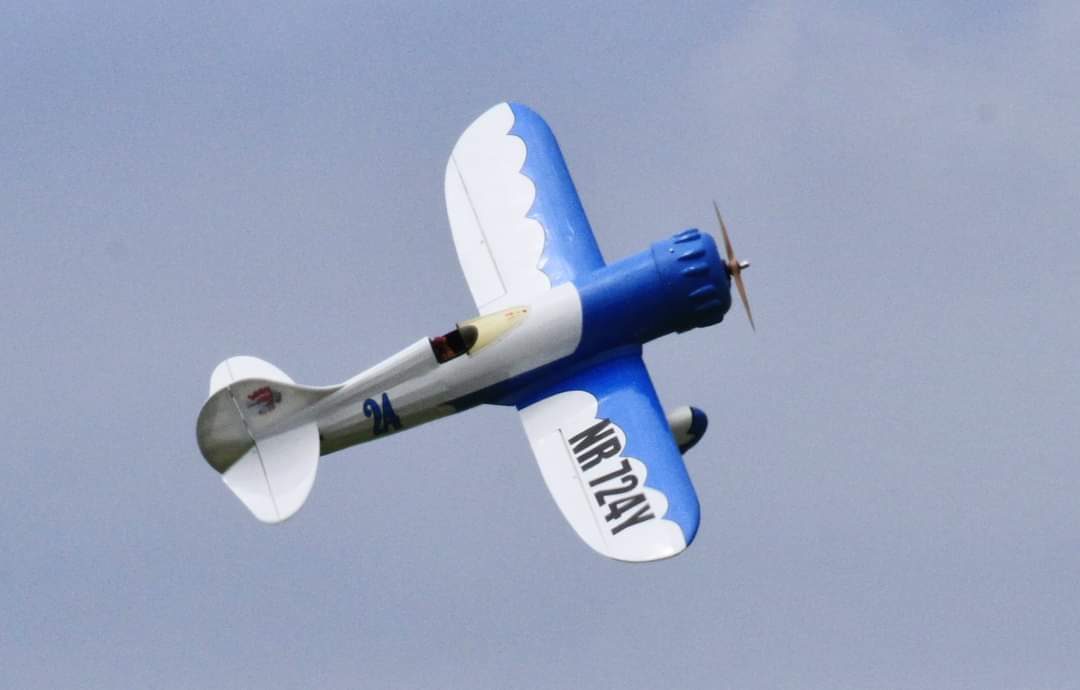
GEE BEE Racer - (Mick Butler)


Powered by a Laser 200 V-Twin glow engine  and turning an 18x6 prop at 9600rpm, Mick constructed this 18lb model to fly as a member of TEAM GB. TEAM GB was established to recreate the pylon racing era of the 1940s. 


ME109E - (Trevor Main)


Many MDMC members will be aware of Trevor Main's ME109E project which he started in December 2006. So, after 2 years what progress has been made?   The accompanying photographs show airframe construction to be almost complete and build quality to an exceptionally high standard. As is customary with Trevor's projects, keeping model weight to a minimum is a high priority. His construction techniques enable him to achieve this without any sacrifice to strength or scale detail.

The model is being built from a Brian Taylor plan which Trevor has had scaled-up from its original 68" wingspan to 97", giving a true 1/4 scale model. Trevor has also calculated that when complete it just fits inside his car!


Estimated finished weight is 25lbs and powered by a MOKI 210 turning a 20x10 prop, performance is expected to be true to scale.

To ensure a scale finish Trevor has had to overcome several technical problems. Wheels, tyres, canopy and spinner were commercially unavailable to acceptable scale and weight criteria, so all of these have been designed  by Trevor for construction from conventional materials.  Also, to achieve a completely enclosed  engine installation, yet still retain easy access to the engine bay, a manifold and silencer system had to be "scratch" built. 
Wheel details.
The tyres are 6-3/8" diameter x 1.5" wide shaped from foam blanks by Alan Odom.
The two piece hubs were turned from plywood also by Alan Odom.

Manifold and Silencer details.
Manifold flange is mild steel with the rigid and flexible pipe work being stainless steel and all silver soldered. The silencer is 1/16" thick alum. and has one internal baffle all tig welded by Simon Askew.

The cockpit interior is very impressive with all instruments and controls custom built based on photographs of the original full size aircraft.

Trevor anticipates having airframe construction complete before this summer, leaving next winter to finish covering and painting. So, Spring 2010 should see the first test flight, and knowing Trevor as we do, no doubt it will be faultless.

No pressure then Trevor!

May 2010 - Update

Over the winter steady progress has been made mainly in adding detail to the basic airfrme and completing installation of servo and undercarriage "plumbing". The engine bay has been painted and fuel proofed. Preparation for airframe painting has now been started with the application of sanding sealer and some paint primer
The photos below give you some indication of the level of detail and the scale of this project. It is worth remembering that this model is completely scratch built.


Ultimate Biplane - (Mark Taylor)


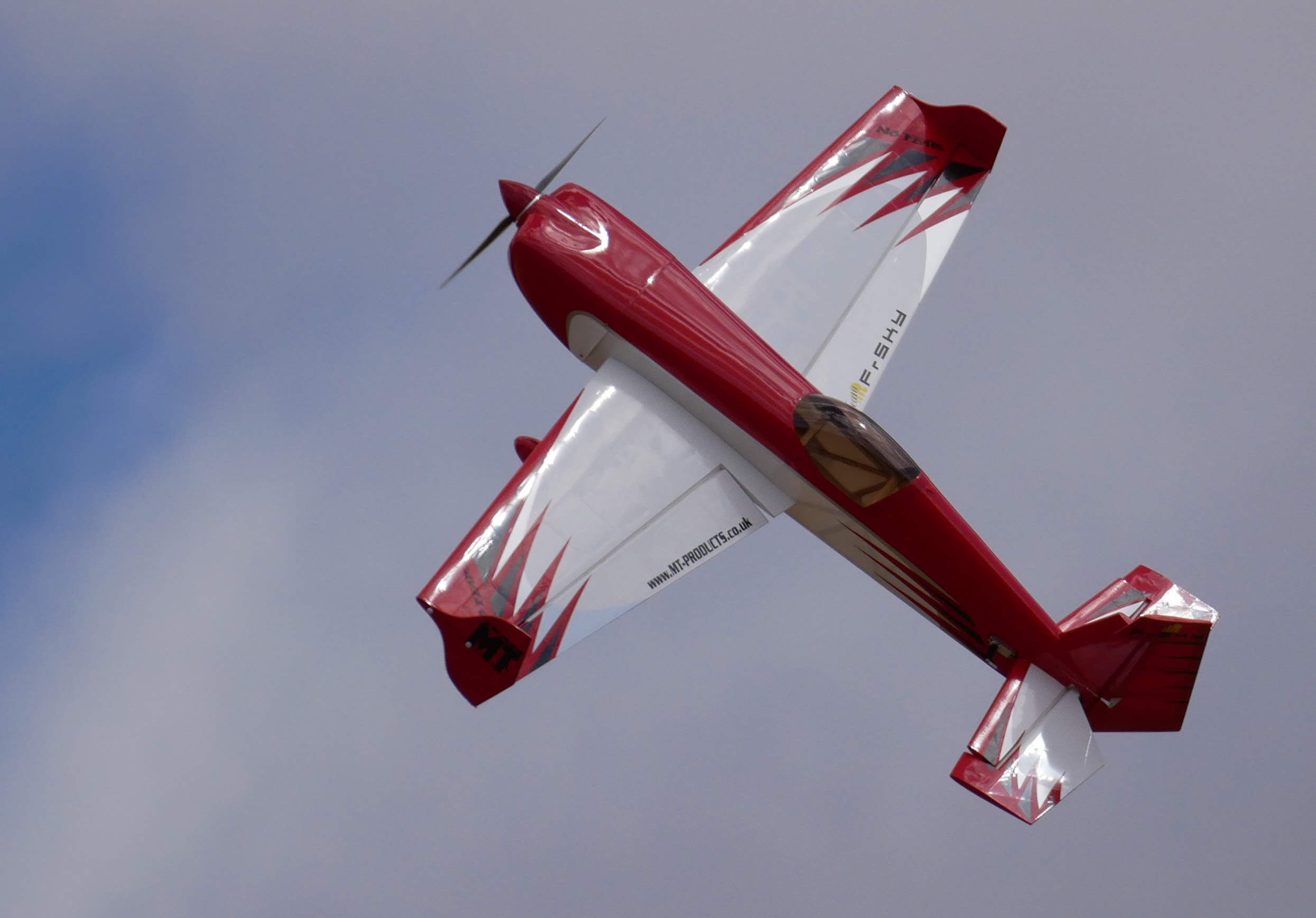
Mark's near half scale biplane has been finished in a very striking colour scheme which Mark designed himself. The photo below does not to justice to the superb finish and the model really needs to be viewed "close up" to appreciate the excellent workmanship.

All control arms, servo arms, fuel and smoke fillers (fuel dots) have been custom made as you can see from the photographs.

Mark has also designed and manufactured the on board smoke system which delivers a really dense smoke trail to compliment the amazing aerobatic manouvers that Mark can demonstrate. If you want to view a video clip of this "monster" being put through it's paces by Mark, click in the box below the photographs.

For the technically minded here is the full specification of this model:

% TOC Ultimate 10-300 Designed by Mike McConville
Powered by DA-150cc and turning a 32 x 10 carbon prop
MT-Smoke-System - my own design
Wing Span: 98.5 in ( 2502mm )
Overall Length: 110 in ( 2974mm )
Wing Area: 3310 sq in
Flying Weight: 19.6kg
Balsa-and-ply construction
Carbon fibere landing gear
Covered in white profilm on top and blue profilm on the bottom
Colour s is all gem stone vinyl graphics made by myself 

RADIO

PowerBox 40/24 Professional powered by 2x 4600 NiMH sub C batteries
Futaba R-5014 DPS 2048 PCM 14ch 35MHz Receiver
Hi-Tec 5955TG 32kg pull servos all around
Seiko PS-050 servo on the rudder powered by it's own 8.4v sub C battery giving 85kg pull !!

ENGINE

DA-150cc Engine
JMB 70mm Canisters, the bulkhead had to be modified to fit the Canisters with air tubes made and fitted inside the fuselage to help cool the Canister.


Website contents © Copyright Melton & District Model Club 2008